Introduction to Foot Zoning Therapy
Physical • Emotional • Mental • Spiritual
Sometimes I’m just a messy human—and I hate that. I can give 100% and still want to give more. I’ll physically push myself until my body makes me stop, but the mental and emotional side of life? Historically, I’ve wanted nothing to do with that.
I like science. I like being physically active. I like anatomy, nutrition, and helping people through a holistic approach—which is ultimately why I gravitated toward massage after nutritional therapy school. Basically my version of switching majors in college.
But Foot Zoning has challenged me in a completely different way. Going through this course and confronting some of the things I’ve had a hard time accepting has been incredibly eye-opening. And I’ll admit—I still strongly side-eye some of the “woo-woo.”
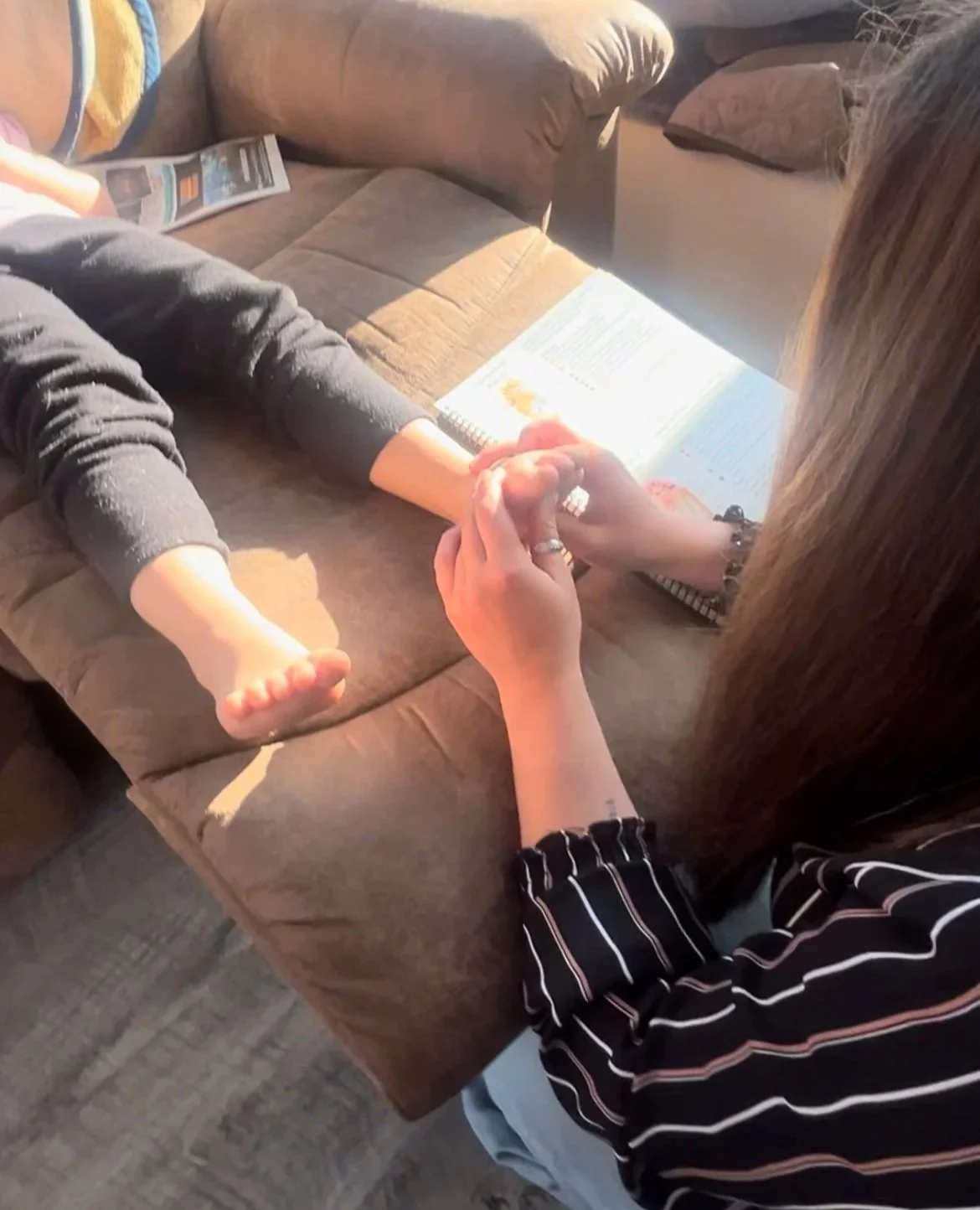
But after actually practicing on the public, seeing patterns, and hearing people’s experiences, I’ve realized there may be a lot more weight to this than I originally thought.
So, enough about me. I wanted to write this for everyone wondering: What the heck is Foot Zoning, how could it help me, and how does it bridge the gap between science and the “woo-woo”?
Let’s get into it. The philosophy behind Foot Zoning looks at the body as an interconnected system—an approach that takes that one step further by considering the physical, emotional, mental, and spiritual person as a whole.
Because our bodies don’t experience life as separate pieces.
Where Did Foot Zoning Begin?
Although working with the feet can be found within much older healing traditions and historical writings, the development of the system that eventually became modern Foot Zone Therapy began taking shape in the early 1900s.
One of its early pioneers was William Fitzgerald, M.D., an American physician specializing in ear, nose, and throat medicine.
Fitzgerald developed a system that became known as Zone Therapy. His theory divided the body into ten longitudinal zones extending from the fingers and toes throughout the body. He observed that applying pressure within one area of a zone appeared to influence other areas along that same zone.
His work helped provide the foundation from which modern reflexology would later develop.
Zone Therapy Becomes Reflexology
Surgeon Joseph S. Riley, M.D. became interested in Fitzgerald’s work, and the two continued developing theories and techniques surrounding the body’s zones.
Riley later taught physiotherapist Eunice Ingham (1889–1974). Ingham became particularly interested in working with the feet. She spent decades refining these techniques and mapping reflex points on the feet that she believed corresponded with different areas and structures throughout the body.
Her work became incredibly influential in the development of modern reflexology, earning her the title “Mother of Reflexology.” Which many of you may be familiar with, but the story didn’t end there.
Reflexology Evolves Into Foot Zone Therapy
Charles Ersdal later expanded upon traditional reflexology. Over decades of studying anatomy, physiology, reflexology, and complementary healing approaches, Ersdal developed a more extensive system of points throughout the feet.
His philosophy was especially interesting:
Rather than simply working with the symptomatic area, he believed the entire body should be addressed. That philosophy eventually became what he called Foot Zone Therapy.
One of Ersdal’s students, Katri Nordblom, brought the practice of Foot Zoning to Montana in 1989, helping introduce the method to the United States.
So, in a simplified way, the evolution looks something like:
Zone Therapy → Reflexology → Foot Zone Therapy
And throughout that evolution, the focus increasingly shifted toward viewing the body as an interconnected whole.
So, What Exactly Is Foot Zoning?
Foot Zoning uses a detailed map of the feet. Imagine yourself in fetal position and overlay that onto your feet — it can feel quite confusing at first, but in session I explain this in further detail (it’s much easier to understand this way!)
Within Foot Zone theory, specific points and areas correspond with different body systems, organs, glands, muscles, tissues, nerves, arteries, veins, joints, and other structures.
During a Foot Zone, rather than randomly massaging the feet or only working where something hurts, I follow a specific sequence of points throughout both feet (if time allows we work through the entire body).
Those points are stimulated using intentional pressure and specific techniques. The traditional theory behind zoning is that stimulating these points encourages internal communication and balance within their corresponding areas of the body.
It is important for me to distinguish the traditional theory from what modern science has established. Research has not proven that an individual point on the foot has a direct pathway to a specific organ or that stimulating that point can diagnose or cure disease.
But … Modern research does continue to show us how communication is constantly occurring between our brain, nervous system, organs, tissues, immune system, hormones, and sensory systems.
And it is helping us better understand something we all have experienced:
Our mental and emotional experiences can have very real physical expressions within the body.
AND… if you don’t believe in any of this, or feel open to it, it’s a good detailed foot rub non the less! 😂
Does the Body Really “Hold” Emotions?
You’ve probably heard phrases such as:
“You’re holding stress in your shoulders.”
“My stomach is in knots.”
“I felt my heart sink.”
“I have butterflies in my stomach.”
There is a reason emotions often have physical descriptions. When we say the body “holds emotions,” I think it’s important to explain what that means. It doesn’t necessarily mean an emotion is physically trapped inside a muscle or that grief, anger, bitterness, etc. is literally stored inside an organ.
Instead, emotions and experiences can influence our nervous system, breathing, heart rate, digestion, muscle tone, hormone signaling, immune system activity, pain perception, sleep, and awareness of physical sensations.
Your brain and body are communicating constantly. And importantly, that communication travels both directions.
The Brain Talks to the Body — and the Body Talks Back
There is actually a scientific term that helps explain part of this:
Interoception.
Interoception is our nervous system’s ability to sense, interpret, and integrate signals coming from inside our body.
Your brain is constantly receiving information about things like:
heartbeat
breathing
hunger and fullness
digestion
temperature
muscle tension
pain
hormonal and internal physiological changes
The brain receives those messages, interprets them, and responds. Meanwhile, the brain is also sending information back into the body.
This creates an ongoing brain ↔ body conversation.
Research into interoception, chronic stress, trauma, and the autonomic nervous system has shown that prolonged or overwhelming experiences can influence how these internal signals are perceived and regulated.
So an experience can technically be “over,” yet the nervous system may continue producing very real physical responses.
That could look like:
Tight muscles.
Shallow breathing.
Digestive changes.
Jaw clenching.
Increased heart rate.
Difficulty sleeping.
Feeling constantly “on.” (you can’t turn your brain off!)
Heightened pain or physical sensitivity.
Or sometimes the opposite—feeling disconnected from parts of the body altogether.
This is where the idea of somatic expression becomes especially interesting. (I know big words sorry, but let me explain..)
When Experiences Become Physical
The word somatic simply relates to the body.
Somatic expression describes the idea that psychological or emotional experiences can have physical manifestations.
Think about what happens when you’re suddenly frightened…
Your heart speeds up.
Your muscles tighten.
Your pupils change.
Digestion becomes less important. Energy is diverted else where, so we may notice slow digestion rate, bloat, weird BM, etc.
Your breathing changes.
Blood flow shifts.
None of that is imaginary.
An emotion created a literal physiological response. Normally, our bodies move through these responses and return toward balance. But chronic stress, repeated emotional experiences, trauma, poor sleep, pain, illness, and many other factors can influence those regulatory systems over time.
This is why I don’t believe we should always separate the question:
“What is happening in your body?”
from:
“What has been happening in your life?”
They may—or may not—be connected.
What Can We Notice Through the Feet?
During a Foot Zone, some points may feel completely normal.
Others may feel:
Tender. Sensitive. Tight. Different in texture or temperature. More reactive than surrounding areas.
I don’t use those responses to diagnose someone!! (no diagnoses, I’m not an MD)
Instead, I look at them as information that allows us to become curious. If a point traditionally associated with a particular area of the body is especially reactive, we might ask:
Have you been sick recently, suppressed immune system, respiratory/sinus issues, allergies?
Have you experienced an injury there?
Surgery? (organ removal, ablation, replacement of joint, etc.)
If it’s correlated to a muscle - Is that area chronically tight?
Has that body system been under additional stress?
When did those symptoms begin?
What else was happening in your life around that time?
And sometimes:
Is there an emotional experience connected to it?
That doesn’t mean every tender point has some hidden emotional meaning.
Sometimes a sore shoulder really is just a sore shoulder!
The purpose isn’t to create a story where one doesn’t exist. The purpose is to listen and reconnect.
Identifying the “Wound”
When I talk about identifying a wound, I don’t necessarily mean an injury. A wound can be physical. But it could also be a stressful season of life.
Grief. Loss. Fear. Anger. Resentment. Feeling Stuck. Suppression of expression. etc. etc.
An experience that changed how safe you felt.
Years of pushing through exhaustion.
Pouring from an empty cup.
An old injury that changed the way you move.
Or simply an area of the body that has been asking for attention.
Sometimes we can identify an obvious connection. Sometimes we can’t. Both are okay.
Foot Zoning isn’t about forcing someone to relive an experience or convincing them that every physical symptom has an emotional cause. It’s about creating space slow down, reconnect, and become aware of what the body may be communicating. Sometimes identification/awareness is where healing begins.
Physical • Emotional • Mental • Spiritual
This is ultimately how I approach Foot Zoning Therapy.
Physical
We physically work with the feet and the mapped points traditionally associated with the body’s systems and structures.
Touch and pressure provide sensory input to the nervous system while allowing us to notice areas of tenderness, tension, sensitivity, and change.
Emotional
Our emotions have physical expressions.
Think about crying when you’re grieving, shaking when you’re frightened, butterflies when you’re excited, or shoulders creeping toward your ears when you’re stressed.
Our emotional and physical experiences are not completely separate. Foot Zoning creates a quiet unique space where someone may begin noticing those connections.
Mental
Sometimes we’re so busy thinking that we’ve stopped listening to our bodies.
During a Foot Zone, we can slow everything down.
Instead of immediately judging a sensation, we can simply become curious:
What am I noticing?
When did this begin?
What makes this better or worse?
What does my body need right now?
Sometimes bringing conscious awareness to something we’ve ignored for years can be incredibly powerful.
Spiritual
We all have God seeds, planted in each of us. Are we spiritually lead, or emotionally fed?
For me, wellness also includes our spiritual health — this is completely voluntary/optional portion and not an avenue required to go down by any means!
A Foot Zone creates space to be still.
To breathe.
To pray.
To reflect.
To reconnect.
And to appreciate just how incredibly and intentionally the human body was designed. Rather than constantly fighting against our bodies, we can begin learning how to listen to them.
It’s All Connected
This is probably the biggest thing I want people to understand about Foot Zoning.
Your digestive system doesn’t operate completely independently of your nervous system.
Your nervous system doesn’t operate independently of your hormones.
Your hormones don’t operate independently of sleep.
Your sleep doesn’t operate independently of stress.
Your muscles don’t operate independently of your nervous system.
And your physical health doesn’t exist in complete isolation from your emotional, mental, and spiritual experiences.
The body is interconnected.
Foot Zoning Therapy gives us another way to explore those connections through the feet.
It isn’t about diagnosing disease.
It isn’t about promising that pressing one point will cure an organ.
And it isn’t about assigning an emotion to every symptom.
It’s about slowing down.
Listening.
Becoming curious.
Working with the body instead of constantly fighting against it.
And looking at the person sitting in front of me as an entire human being:
Physical. Emotional. Mental. Spiritual.
Because sometimes the first step toward healing is simply becoming quiet enough to hear what your body has been trying to tell you.
A Note About Foot Zoning & Research
Foot Zoning is a complementary wellness practice and is not intended to diagnose, treat, cure, or replace medical care.
Research continues to investigate reflexology as well as the relationships between touch, stress, the autonomic nervous system, interoception, trauma, pain, and somatic symptoms.
Modern research supports extensive two-way communication between the brain and body and demonstrates that psychological stress and emotional experiences can produce measurable physiological responses. However, the specific organ and body maps used in reflexology and Foot Zoning have not been “scientifically established as direct anatomical pathways.” Yet Foot Zoning yielded wonderful results and benefits to people who have experienced Zones for decades upon decades.
I believe both perspectives can be respected: we can continue learning from the traditions and observations that shaped Foot Zoning while also remaining curious about what modern research continues to uncover about the incredible connection between the brain, nervous system, and body.
Please feel free to reach out with any and all questions you may have about Foot Zoning!! And I hope this blog provided good insight into what I’ve been learning through my schooling:)
-Lex 🤍