Pressure in Massage: More Isn’t Always Better

One of the most common things I hear from clients is:
“I want deep pressure.”
And I get it — I love deeper pressure massage myself. Truly. Light pressure has never been my thing, which is also why I don’t offer a pure lymphatic-specific massage. Extremely light pressure (think just a few ounces - 4 oz to be specific) feels more like petting someone — and I personally couldn’t imagine doing or receiving that for an hour or more.
That said, it’s time to clear something up.
Deep pressure or “deep tissue” massage isn’t all it’s cracked up to be — at least not in the way it’s often advertised.
What Deep Work Actually Requires:
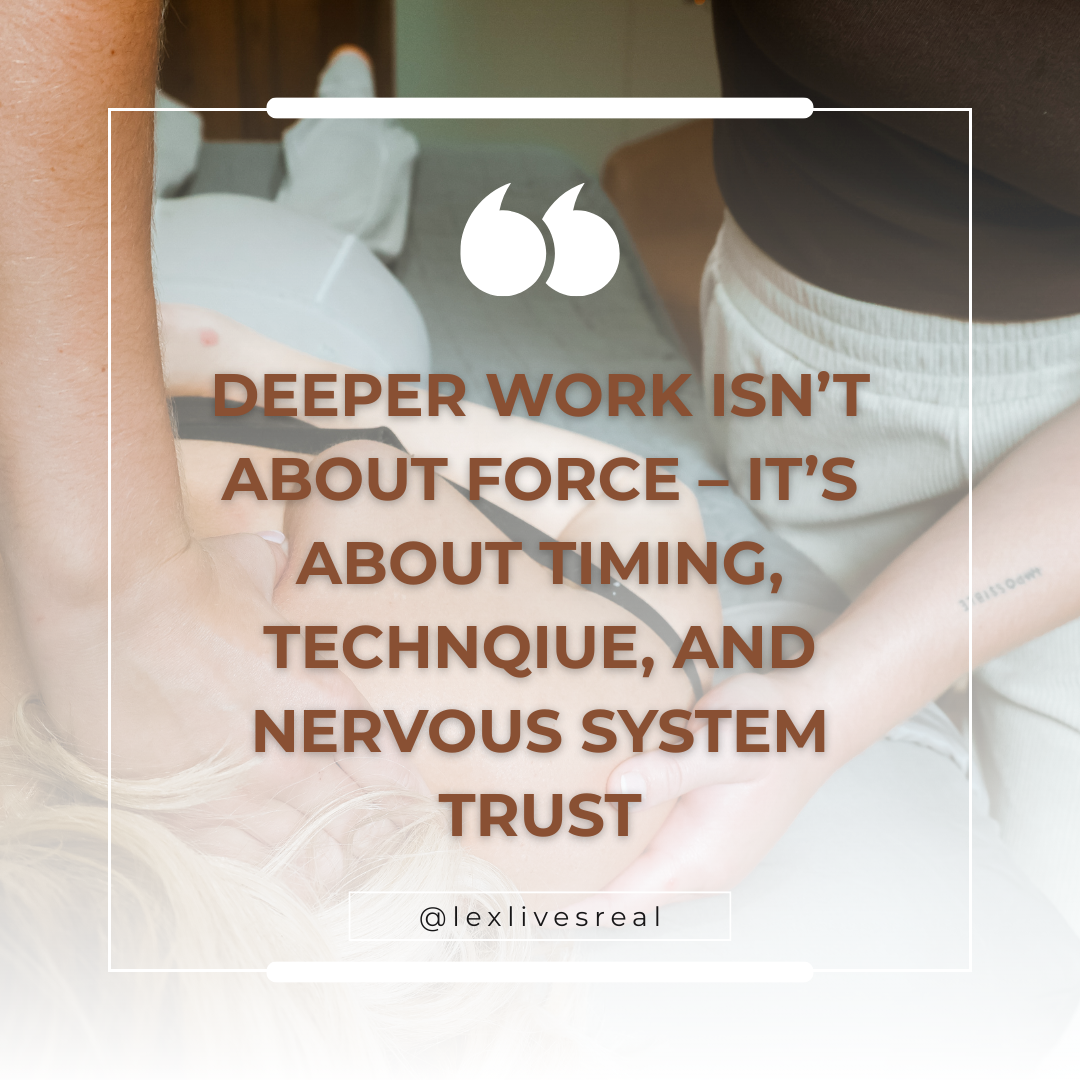
Effective deep work doesn’t come from muscling your way through tissue.
Your body cannot and will not release tension unless the nervous system feels safe enough to let go. When pressure is forced too quickly or aggressively, the body does the opposite — it guards, tightens, and resists. This is why simply pushing harder rarely creates lasting change.
To truly access deeper layers of tissue, the body needs:
• A variety of techniques
• Gradual changes in pressure
• Time for the nervous system to settle
• Intentional pacing
When the nervous system relaxes, that’s when you can sink in and work deeper — without fighting the body.
Why Variety in Pressure Matters:
Deep tissue work is most effective when it’s layered. That often means starting lighter or slower, then gradually increasing depth as the tissue responds.
Pressure may change multiple times throughout a session depending on:
• How the tissue feels that day
• Areas of inflammation or restriction
• Stress levels and overall nervous system tone
Deeper pressure applied at the right time is far more effective than constant force from start to finish.
More Pressure ≠ Better Results
A massage shouldn’t feel like a battle between therapist and tissue. If the body is bracing the entire session, it’s not releasing — it’s surviving.
True therapeutic work feels intentional, specific, and responsive. Sometimes that includes deeper pressure. Sometimes it doesn’t. And often, it’s the combination that creates the best results.
The Bottom Line
I’m not anti-deep pressure — far from it.
I’m anti-force.
Massage works best when pressure is used strategically, not aggressively. When the nervous system is supported first, the tissue follows.
That’s where real change happens.
Your LMT, Lex 🤍🤍
Further sourcing, incase you don’t believe me;) or have further Interest!
• Schleip, R., Müller, D. G., & Klingler, W.
Fascial plasticity – a new neurobiological explanation.
Journal of Bodywork and Movement Therapies
→ Supports that fascial change is mediated by the nervous system, not force alone.
• Porges, S. W.
The Polyvagal Theory: Neurophysiological Foundations of Emotions, Attachment, Communication, and Self-Regulation.
→ Explains why safety, pacing, and nervous system regulation are required for tissue release.
• Field, T.
Massage therapy research review.
Complementary Therapies in Clinical Practice
→ Demonstrates massage effects on parasympathetic activation, cortisol reduction, and muscle tone.
• Moyer, C. A., Rounds, J., & Hannum, J. W.
A meta-analysis of massage therapy research.
Psychological Bulletin
→ Shows outcomes are influenced by technique, intention, and client response — not intensity alone.
• Crane, J. D., et al.
Massage therapy attenuates inflammatory signaling after exercise-induced muscle damage.
Science Translational Medicine
→ Supports recovery benefits without requiring aggressive pressure.